|
 |
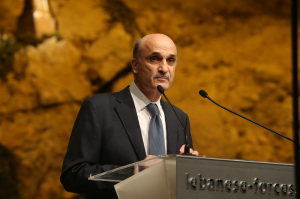
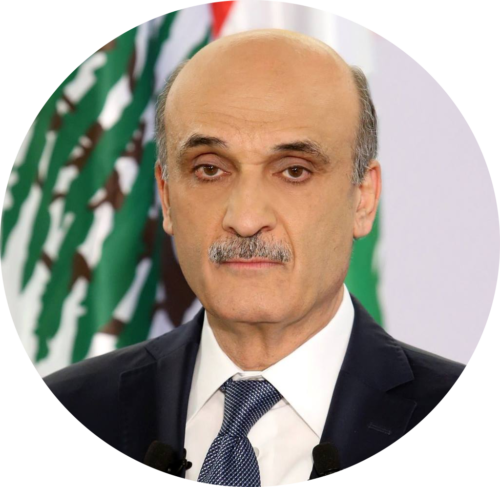
Samir
Geagea - Leader of the
Lebanese Forces

Samir Geagea (born October
25, 1952) is the formerly
imprisoned leader of the
Lebanese Forces (LF) militia.
Geagea served what were
to be several life sentences
for crimes allegedly committed
during the Lebanese Civil
War of 1975-1990, but
he was pardoned by the
government of Lebanon
on July 18, 2005. He remains
the only civil war-era
leader to have stood trial
for crimes committed during
the war.
Geagea was born in Ain
el-Rummanah in Beirut
in 1952 to parents from
the Maronite town of Bsharri
in the mountains of Northern
Lebanon. While studying
medicine at the American
University of Beirut,
he became an active member
of the right-wing Phalangist
Party, which became the
main Christian fighting
force upon the outbreak
of the Lebanese Civil
War in 1975. He steadily
rose through the ranks
and led several daring
operations at the request
of Bashir Gemayel, then
commander of the Phalangist
militia (a right-wing
movement advocating Maronite
political participation
in Lebanon). In 1983,
he led the defence of
the Shouf Region in Central
Lebanon against an onslaught
by various militias especially
by those led by the later
ally Walid Jumblat that
were supported by the
Syrian Army. Geagea was
appointed head of LF's
northern Front in the
early 1980s, where he
commanded around 1,500
battle-hardened soldiers,
drawn mainly from his
native town of Bsharri
and other towns and villages
in Northern Lebanon. This
loyal following would
later ensure his ascension.
In 1984 Geagea and Elie
Hobeika orchestrated an
internal coup in order
to end the leadership
of Fuad Abu Nader on the
Lebanese Forces. Abu Nader
was considered to be too
close to his uncle, president
Amine Gemayel whose policies
were not accepted by most
LF leaders. In 1986, Geagea
became head of the Lebanese
Forces after overthrowing
Hobeika, who was widely
accused of treachery in
the Lebanese Christian
sector for agreeing to
a Syrian-sponsored accord
(the tripartite agreement).
Geagea transformed the
LF into a formidable fighting
force and nurtured links
with Iraq, which developed
into a major source of
weaponry and support due
to its animosity towards
Syria. He also developed
a highly organised civil
infrastructure in area's
under LF contol. In 1989,
Geagea approved of the
Taif agreement which aim
was to put an end to the
lebanese war.
Geagea initially supported
General Michel Aoun's
military campaign, with
the declared intention
of freeing Lebanon of
all foreign forces, launched
in 1989. However, he later
began to question Aoun's
motives in pursuing such
a destructive and unpromising
war against the much larger
Syrian Army and its leftist
allies. When Aoun began
taking active steps to
undermine and dissolve
the LF, Geagea resisted
violently. This resulted
in a devastating war in
1990 between the LF and
Lebanese Army units loyal
to Aoun.
The post-war period
Aoun surrendered on 13
October 1990 after the
Syrian army expelled him
from the Baabda presidential
palace. This date is considered
to mark the end of the
civil war. Geagea was
subsequently offered ministerial
portfolios in the new
Lebanese government several
times. However, he declined
on the grounds of opposition
to Syrian interference
in the internal affairs
of Lebanon. In 1994, Geagea
was arrested on charges
of attempting to undermine
government authority by
"maintaining a militia
in the guise of a political
party," of instigating
acts of violence, and
of committing assassinations
during the Lebanese Civil
War. Prior to his arrest,
he was contacted by several
sympathetic politicians
and warned about the forthcoming
proceedings and offered
safe passage out of Lebanon.
Geagea refused to leave
and was subsequently arrested,
tried and sentenced to
life imprisonment on several
different counts. Many
members of the LF were
allegedly subjected to
horrific torture techniques
in the process of being
interrogated, resulting
in the death of at least
one LF official under
interrogation. The evidence
used by the Lebanese authorities
to convict Geagea was
criticized by some as
unreliable, circumstantial,
and inconsistent. Human
rights groups including
Amnesty International
decried the judicial process
leading to his conviction
as seriously flawed and
politically motivated.
He was incarcerated in
solitary confinement in
a small cell three floors
underground in the Lebanese
Ministry of Defense, with
his access to the outside
world severely restricted.
During his incarceration,
support for Geagea among
Lebanese Christians remained
high, and by some accounts
has even increased . Despite
widespread calls for his
release by notable politicians
and clerics, all lebanese
pro-syrian governments
refused to grant Geagea
a pardon during the 1994-2005
period. Geagea is said
to have rejected an offer
of a presidential pardon
that would have restricted
his ability to participate
in political activity.
Speaking to a delegation
from the Lebanese Parliament's
Human Rights Committee,
which visited him in prison
in November 2004, Geagea
said, "I would prefer
to remain in prison for
another 20 years than
bargain my beliefs for
freedom." Calls for his
release intensified after
the Cedar Revolution and
the subsequent withdrawal
of Syrian troops from
Lebanon in 2005. Several
public figures openly
conceded that Geagea's
arrest, trial, and incarceration
were engineered by the
Syrian-backed political
order in response to his
movement's hostile stance
towards the Syrian presence
in Lebanon.
The Lebanese Parliament
passed legislation on
18 July 2005 to free Samir
Geagea. Only the Hezbollah
deputies abstained from
voting. Geagea's party,
the Lebanese Forces, held
major celebrations throughout
Lebanon.
Geagea was released from
prison 26 July 2005 and
left Lebanon for medical
tests. "I have spent 11
horrific years in solitary
confinement in a 6-square-meter
dungeon three floors underground
without sunlight or fresh
air. But I endured my
hardships because I was
merely living my convictions,"
he was quoted saying upon
his release. He returned
on October 25 (the day
of his birth), and currently
lives in the cedars region
in north Lebanon.
[source wikipedia]
|
|
|
|
|